“The Big Word for This Program Is Listening”
When Sr. Ireen Makovere first felt drawn to religious life; she did not know much about congregations, formation or discernment. She thought becoming a sister was a job she needed to apply for.
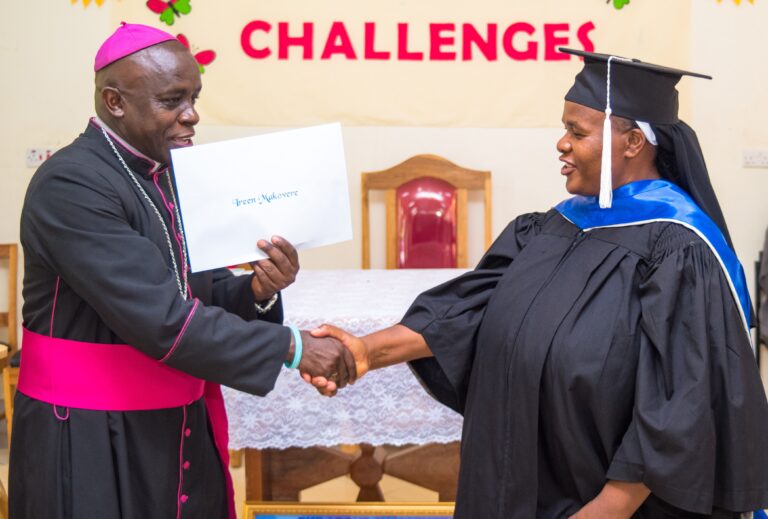
“I applied to the Mother General for a job as a sister,” the Dominican Sister from Zimbabwe recalled humorously during an interview ahead of the May 8 graduation ceremony of the 26th Session of the St. John Paul II Sabbatical Program.
The journey that followed would lead her into nearly three decades of religious life, service in education and leadership, and eventually to the St. John Paul II Sabbatical Program in Kenya, where she says she found something she had not realized she needed: the healing power of being listened to.
Sr. Makovere professed her vows in 1997 and has served as a member of the Dominican Sisters for 29 years. Looking back, she describes her vocation as a simple response to God’s call. “For me, I think it was simply God’s call,” she reflected. The call came unexpectedly. She recalls suddenly developing a desire to pray the rosary and finding herself increasingly drawn to religious life.
Not knowing much about different congregations, she and her family visited a post office where they found a list of religious institutes. Among them was the Dominican Sisters congregation, which stood out because it was the only one without an acronym.
“I said, ‘These Dominicans,’” she recalled with a smile.Thinking religious life was something one applied for like a job, she wrote to the Mother General expressing her interest. Within a week, she received a response inviting her for a “come and see” experience. What began as a seemingly random choice eventually grew into a deep appreciation of the Dominican charism and mission.
“I love my congregation. It’s beautiful,” Sr. Makovere said, referring to the Dominican Sisters, also known as the Order of Preachers. She says the congregation’s emphasis on evangelization and proclamation of the Gospel has enriched her vocation, while its international presence has exposed her to diverse cultures and broadened her understanding of mission.
Over the years, much of Sr. Makovere’s ministry has been dedicated to education. In Zimbabwe, she has served as both a teacher and school head, working in five different schools over the course of her religious life.
“I have a passion for teaching,” she said.
Her commitment to education also led her to pursue further studies, including a Master’s degree in Educational Leadership in the United States. She is now preparing to begin doctoral studies in Environmental Stewardship, an area closely linked to another lifelong passion: care for creation.
A strong advocate for environmental conservation, the Dominican Sister is involved with environmental and wildlife initiatives in Zimbabwe and draws inspiration from Pope Francis’ encyclical Laudato Si’, which calls for greater care of our common home. That love of nature became an unexpected source of comfort during her time at the sabbatical centre.
“When I came, I was sad,” she recalled. “I was sad and angry because of what had happened where I was coming from.” The Zimbabwean Sister arrived carrying emotional pain and unanswered questions. The serene environment of the St. John Paul II Sabbatical Program immediately began to calm her.
“I am a nature person,” she explained, pointing to the well-kept grounds, trees, flowers and even the small animals that inhabit the property. She laughed as she recounted becoming attached to them. “The cats, the rabbits, the fish, the cows. I named all the cows. They will miss me.”
Yet beyond the beauty of the surroundings at the program nestled in the middle of a typical African village in Central Kenya, Sr. Makovere says the greatest gift of the experience was something much deeper.
“The big word for this program is listening,” she reflected. For a religious whose ministry has largely revolved around teaching, leadership and public speaking, the experience of being listened to proved profoundly healing.
“Many times we want to speak, speak, speak, speak, speak,” she explained. “And then when you come to a place where a person listens to you, it is therapeutic. It’s almost like you’re going for counseling.”
Through personal accompaniment, group interactions and conversations with facilitators, the Zimbabwean religious found a safe space to share her experiences, process difficult emotions and gain fresh perspective. “The facilitators met us where we actually were,” she said. “They allowed us to share our own experiences, which allowed healing.”
She also appreciated the structure of the four-month residential program, particularly the balance between guided activities and personal reflection. “This place is a home,” she said. “I found that the program, the way they have prepared it, is perfect for me.”
As the 26th Session came to an end, Sr. Makovere said she left the sabbatical program with a renewed sense of peace and gratitude. “I found peace and healing at this place,” she reflected.
“It is a place I would recommend to others,” she said. “It’s perfect.”
The St. John Paul II Sabbatical Program is a ministry of Kenya’s Catholic Diocese of Murang’a. Established in August 2013 by Bishop James Maria Wainaina, the program provides priests and religious with a residential space for rest, renewal and personal growth. Through a holistic approach, the program seeks to help participants integrate their physical, spiritual and emotional lives with their apostolate and ministry.
Inspired by Sr. Makovere’s sabbatical experience? Applications for the 27th Session of the St. John Paul II Sabbatical Program, set to begin on August 3, are ongoing. Apply today by visiting: St. John Paul II Sabbatical Program Application Page